

When an online dating match asks for money, you can say no before proving that the story is false. Warm conversations, promises to meet and urgent emergencies do not make you responsible for funding someone you have only met online.
Pause the payment and protect your accounts. If you have already sent money or exposed financial information, contact the relevant bank or payment provider promptly through an independently verified route. Being targeted is the scammer's responsibility.
A money request needs a pause
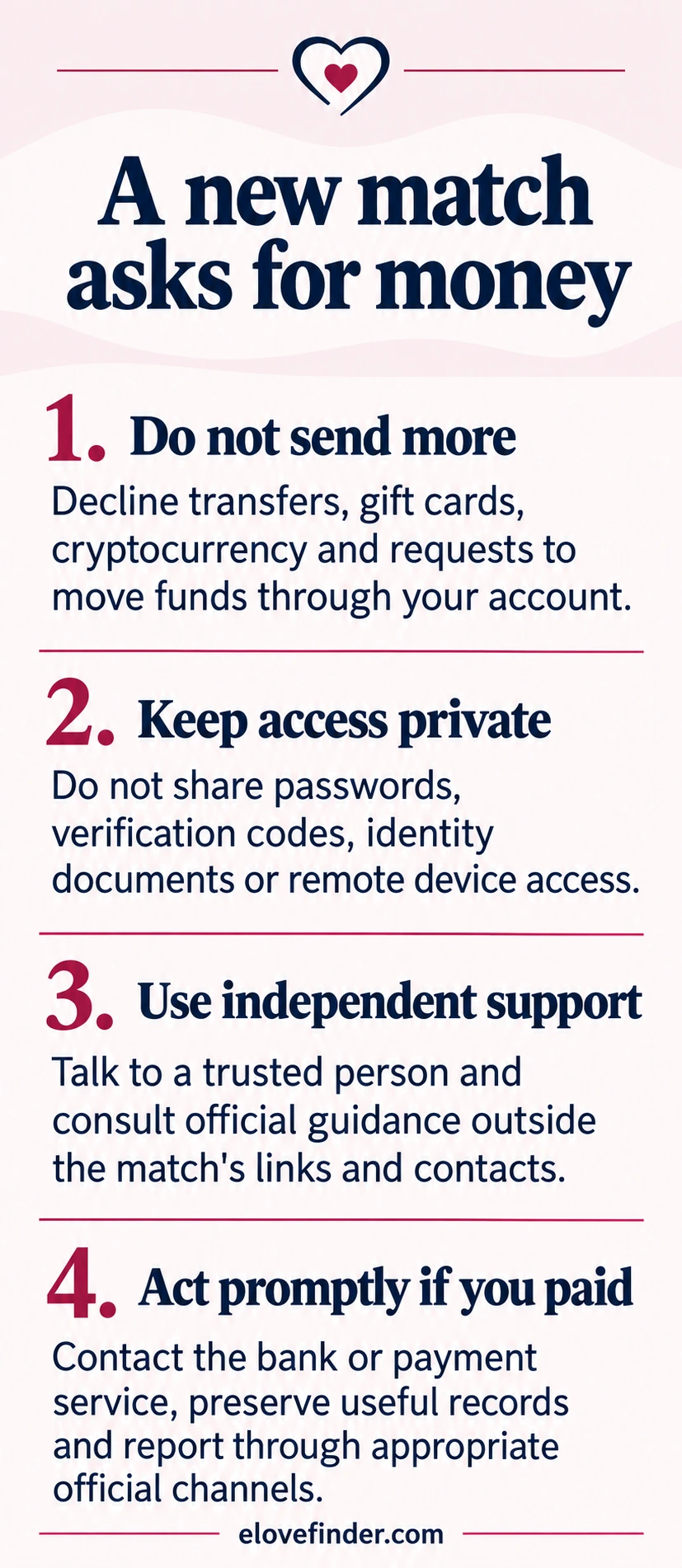
Read the guide as text
- Do not send more. Decline transfers, gift cards, cryptocurrency and requests to move funds through your account.
- Keep access private. Do not share passwords, verification codes, identity documents or remote device access.
- Use independent support. Talk to a trusted person and consult official guidance outside the match’s links and contacts.
- Act promptly if you paid. Contact the bank or payment service, preserve useful records and report through appropriate official channels.
Making Financial Decisions in Dating Someone New
You can have a good conversation with someone and still refuse to give them money. Affection should never require you to lend money, invest, or pay someone. You should ask yourself, "Do I like talking to this person?" and "Is there a good reason to give them money?" The first answer doesn't answer the second question.
You can set a brief boundary, such as, "I don't send money to people that I meet online." You don't have to talk about your account balance or explain whether you could afford it. Don't bargain with them over a smaller amount just to keep the connection strong. Even if they ask for less money, it can still cause the same pressure. You need to have boundaries in the situation, not just if the person finds a small enough amount to make it hard for you to refuse.
What Happens if You Refuse?
Pay attention to what happens if you refuse to give money. If the person gives a respectful answer, this is good, but if they become more urgent, angry, or threatening, this is useful information. They might tell you that nobody else will help them and that you're their only chance, but these claims still need to be considered when making financial decisions.
You can care about their situation without becoming financially involved. A person facing an emergency can seek appropriate local help; their new date is not obligated to fund it. Don't let a deadline replace your judgment, and an urgent story doesn't mean you're obligated to give them money.
Pay Attention to Patterns
Someone might ask you to give them money so they can meet up with you, get medical treatment, or because of a blocked account. The details can change, but the situation stays the same: there's an obstacle between you and the promised relationship.
Another situation can start with financial help for you. The match might introduce you to a trading platform and then encourage you to make a small deposit, but withdrawing might require more payments.
The FBI explains how romance scams use false identities and relationships to gain trust. You do not need to memorize every story to use a clear financial boundary. Be cautious about trying to identify a scam only by nationality, spelling, profession, or age. Those shortcuts can miss sophisticated deception and unfairly stigmatize genuine people. Focus on behavior, requests, pressure, and independently verifiable information.
Be Careful When Someone Asks You to Send Money
When you're dating online, it's important to be careful about how someone asks you to send money. Requests involving gift cards, cryptocurrency, wire transfers, or payment apps can be especially risky because getting your money back might be difficult or even impossible. Just because you're familiar with a payment app or another way of sending money doesn't mean the person receiving it can be trusted.
You should also be careful about sharing personal or financial information with someone you've met online. Never give someone your banking passwords, verification codes, pictures of your credit cards, or copies of your identification because they claim to need help with a problem. You also shouldn't give someone remote access to your phone or computer or agree to move money through your bank account on their behalf.

Another thing to watch for is someone sending you a check and asking you to deposit it before sending part of the money somewhere else. Even if your bank account shows that the money is available, that doesn't necessarily mean the check is real. It can take time for a bank to discover that a check is fraudulent. Before doing anything with a suspicious payment, contact your bank using a phone number or website you've found yourself.
You don't have to understand every type of payment scam to protect yourself. Sometimes it helps to ask one simple question: "Why is someone I barely know asking me to risk my money or personal information when I can't even verify their situation?"
If the only explanation involves trusting them because you're developing romantic feelings, that's a good reason to stop and reconsider. Someone who genuinely wants a relationship with you shouldn't expect you to put your finances or identity at risk to prove that you care.
Don't Believe Everything Someone Shows You Online
When you're getting to know someone through a dating app or website, pictures, video calls, and personal information can make them seem trustworthy. But just because someone sends you a photograph, shows you identification, or has a professional-looking social media profile doesn't mean everything they're telling you is true.
Photographs and documents can be stolen, changed, or used to create a false identity. Screenshots can also be misleading, and even someone who appears on a live video call might not be honest about their job, financial situation, or reasons for asking for help.
One thing you can try is doing a reverse image search to see whether someone's profile pictures appear somewhere else online. This might help you discover that they're using photographs taken from another person's account. But remember that not finding any matches doesn't automatically mean the person is who they claim to be. It's simply one way to look for possible warning signs.
You also don't need to start asking someone for copies of their passport, driver's license, or other sensitive documents to prove they're telling the truth. These documents can be altered or stolen, and exchanging personal information can create more risks for both people. You shouldn't feel pressured to share your own documents just because someone else has offered to show you theirs.
If someone makes a claim that you want to verify, try finding the information through an independent source instead of relying on a phone number, website, or contact person they provide. For example, if they claim to work for a particular company, you can look up the company's official contact information yourself. But even confirming someone's workplace doesn't prove that everything else they're saying is true.
The important thing is remembering that you don't have to investigate every detail of someone's life to justify protecting yourself. If you're uncomfortable with a request for money or personal information, you have every right to say no.
Dating should be about getting to know someone and building a connection, not feeling like you have to become a detective just to keep your money and personal information safe.
Ask Someone You Trust
When emotions are involved, take time to pause, but this can turn into hours of rereading the same messages. You can ask someone you trust to come in and look at the situation. You might say that someone you met online is asking for money, and you want a second point of view before you do anything. Only share the details that you need to explain what's going on.
Choose someone who can respond practically and kindly. Shame can cause people to be more secretive, and this benefits the person who's pressuring you. If the first response is dismissive, get another reliable source of support.
Asking a second person can help you look at the emotional story of the transaction, such as who gets the funds, what's being asked for, and what is being independently checked. Also, ask what happens if you say no, because these questions can make the pressure easier to see.
If You Sent Out Money
If you have already sent someone money, contact the bank, payment provider, or card issuer. Explain that you believe the payment was part of a scam and ask what options are available for you. There's no guarantee that you'll get your money back, but contacting them quickly does matter.
Don't send another amount of money to get your funds released or reverse a transfer. A request for money can be another stage of the scam, according to the FTC, which explains practical steps after different types of scam payments. Use the guidance relevant to the method you actually used.
Keep a record of the dates, amounts, transactions, and the organization you contacted. You don't have to have a perfect report to ask for help. You should start with the most urgent action and then add details when you can.
Talk About Exposed Information
This response depends on what is being shared. A name, general interest, and questions about what you like are different from banking login, identity documents, and remote access to devices.
Tell exactly what happened, and ask about securing accounts, looking at transactions, and whether identity protection can help you. Follow the instructions instead of a link from the person who contacted you.
If your passwords were exposed, secure the account through a trusted route and look at other accounts where the same password was used. If you think the device was compromised, get technical assistance.
Don't post your document or the full transaction records in a public group when asking for help. These details can cause more exposure, and you can describe the problem without giving sensitive information.
Advance fees to recover money
After you lose money, someone might say they can get your money back for a fee. They might act like a professional investigator or officials. Look at the recovery promises with caution.
The first person might have come back with a different account, an apology, or a story about being forced into the situation. You don't need to allow them to contact you again, even for an explanation.
Keep your boundaries based on your behavior: say that you won't send money, allow access, or follow financial instructions from contacts you don't know. This is a good boundary, even if your story changes.
If someone makes a new contact to try to get a hold of you, tell someone you trust before you make any decisions. Emotional attachment can stay even if you know you've been deceived. Missing the conversation doesn't mean that it's safe for you to resume financial involvement with them.
Showing Support
If a friend is being targeted, start with that instead of overreacting. You might say, "I'm worried about the money requests and the pressure to act fast," instead of saying something like, "How can you believe this?"
Focus on the transaction and offer help, such as looking at the official guidance together, contacting the bank, and looking at real records. Don't demand every private message to prove to you that they need help.
A person might be feeling loyalty, anger, embarrassment, or grief all at once, and you should let them speak without treating their feelings as a lack of judgment. Shaming someone can drive them away from support and toward the contact who is pressuring them.
Do not send money to the match yourself to test the story or try to rescue your friend. Support a person you care about with safe and independent actions. You can stay compassionate but still keep boundaries on your own finances.
Being More Confident
Being targeted doesn't mean you're unable to have a healthy dating period. The scammer is responsible for choosing deception. You can learn from the experience without accepting blame for their actions.
If you need to take a break from dating and get counseling or support when stress or shame affects your daily life, do so. Try to take small recovery and emotional steps that can help you feel better but know that this happens at different times.
When you go back to dating, keep a rule: romance doesn't mean you should send money, give account access, or send money for investment. You can enjoy getting to know someone but still keep your financial boundaries.
If your new match asks for money, this is a time to pause, and it shouldn't be used to test your generosity. Protect your resources and leave room for the relationship to develop through respect, time, and a life you can live together.
Choose your next scam-response steps
Select the closest situation for a short action list. You do not need to enter names, account details or amounts.
Use official provider contacts. This tool cannot recover money or access accounts.
Use the questions and examples in the article above; the draft builder needs JavaScript.
15 questions readers ask
1. Does a money request prove someone is a scammer?
It is a serious warning sign, especially when you have only met online. You do not need proof of fraud before declining or protecting your accounts.
2. What is a clear response?
You can say that you do not send money to online romantic contacts. You do not owe account balances, a smaller payment or a debate.
3. What if the emergency sounds real?
Urgency does not create an obligation. Do not use the match's deadline as a reason to bypass independent judgment.
4. Are gift cards or cryptocurrency safer than cash?
No. They can be difficult to recover. A familiar payment method does not establish that the recipient is trustworthy.
5. Does a video call prove the story?
No. A video call does not verify the person's financial claims or reason for requesting money.
6. Can reverse image search help?
It can reveal reused photographs. No match does not prove identity or eliminate scam risk.
7. Should I ask for their passport?
Do not exchange sensitive identity documents as a dating trust test. Documents can be stolen or altered, and sharing yours creates further risk.
8. What if they offer an investment opportunity?
Do not invest through a romantic contact's platform or instructions. Requests for more money to unlock withdrawals are a serious warning sign.
9. What if they send me a check first?
Do not forward funds on their behalf. Available funds do not prove a check is genuine; contact your bank through a trusted route.
10. What should I do if I already paid?
Contact the bank, card issuer or payment provider promptly, explain the suspected scam and ask about reversal or recovery options. Recovery is not guaranteed.
11. Should I pay a fee to recover lost money?
Be cautious of unsolicited recovery promises and demands for advance fees. Use official contacts and do not send more money to release supposed funds.
12. What if I shared a password or code?
Secure the account through a trusted route and notify the relevant provider. Review other accounts using that password and seek technical help if a device was accessed.
13. Where can I report it?
Report the profile to the dating service. In the United States, the FTC and FBI's Internet Crime Complaint Center provide official reporting routes.
14. How can I support a friend without shaming them?
Focus on the money request and pressure. Offer to review official guidance or contact their bank together without demanding every private message.
15. Can I still miss someone who deceived me?
Yes. Attachment or grief can remain. Those feelings do not make renewed contact or financial involvement safe; seek supportive help if needed.