

Some people use the word “empath” to describe how strongly they respond to the moods of others. You might think of that as spiritual sensitivity or notice it in everyday cues such as a shift in tone. Either way, you can take your own reaction seriously and give the other person room to tell you how they feel.

Setting a boundary before you feel drained
Decide how much time or attention you can offer. For example, “I can listen for ten minutes now, and then I need to get back to work.” A specific limit makes it easier to be present while you’re available.
Taking a short pause
After an intense conversation, sit quietly for a moment or use a meditation you already find helpful. If you prefer someone to lead you through the exercise, try guided meditation. Notice how you feel before taking on another conversation or decision.
Finding your footing
Try a short walk, feel your feet on the floor or look around and notice a few ordinary details. Choose something that helps you return your attention to where you are.
Using a visualization as a reminder
If imagining a shield, praying or carrying a crystal has meaning for you, use it as a reminder of the boundary you intend to keep. Leave the situation or ask for help if someone ignores your limits.
Noticing what leaves you tired
Look for patterns across several days. A loud room, lack of breaks, a long shift or recurring conflict can all make an interaction feel heavier. Change one thing at a time so you can tell what helps.
Checking your basic needs
Before interpreting what you feel, check whether you’ve eaten, slept or taken a break. You can also choose quieter entertainment when you’ve already had a demanding day.
Checking an impression with a question
“They answered in a short voice” is something you observed. “They’re angry with me” is a possible explanation. If it’s appropriate, ask “You seem quiet today. Would you like to talk or have a little space?”
Offering help without taking over
Ask what kind of support would actually help. Someone may want you to listen, lend a hand with a task or give them space. You can accept their answer and keep your own limits.
Keeping a transition ritual
A shower, a bath or a few minutes of prayer can mark the end of a hard day. Choose a ritual that fits your beliefs and is easy to keep when you’re tired.
Making room for quiet time
If social time regularly leaves you worn out, plan a buffer afterward. Take twenty minutes before your next commitment, then see if you need more.
Getting support when the strain continues
If you often feel responsible for other people’s moods or find it hard to manage your own, talk with someone you trust. A qualified counselor can help you find ways to care for yourself and stay connected.
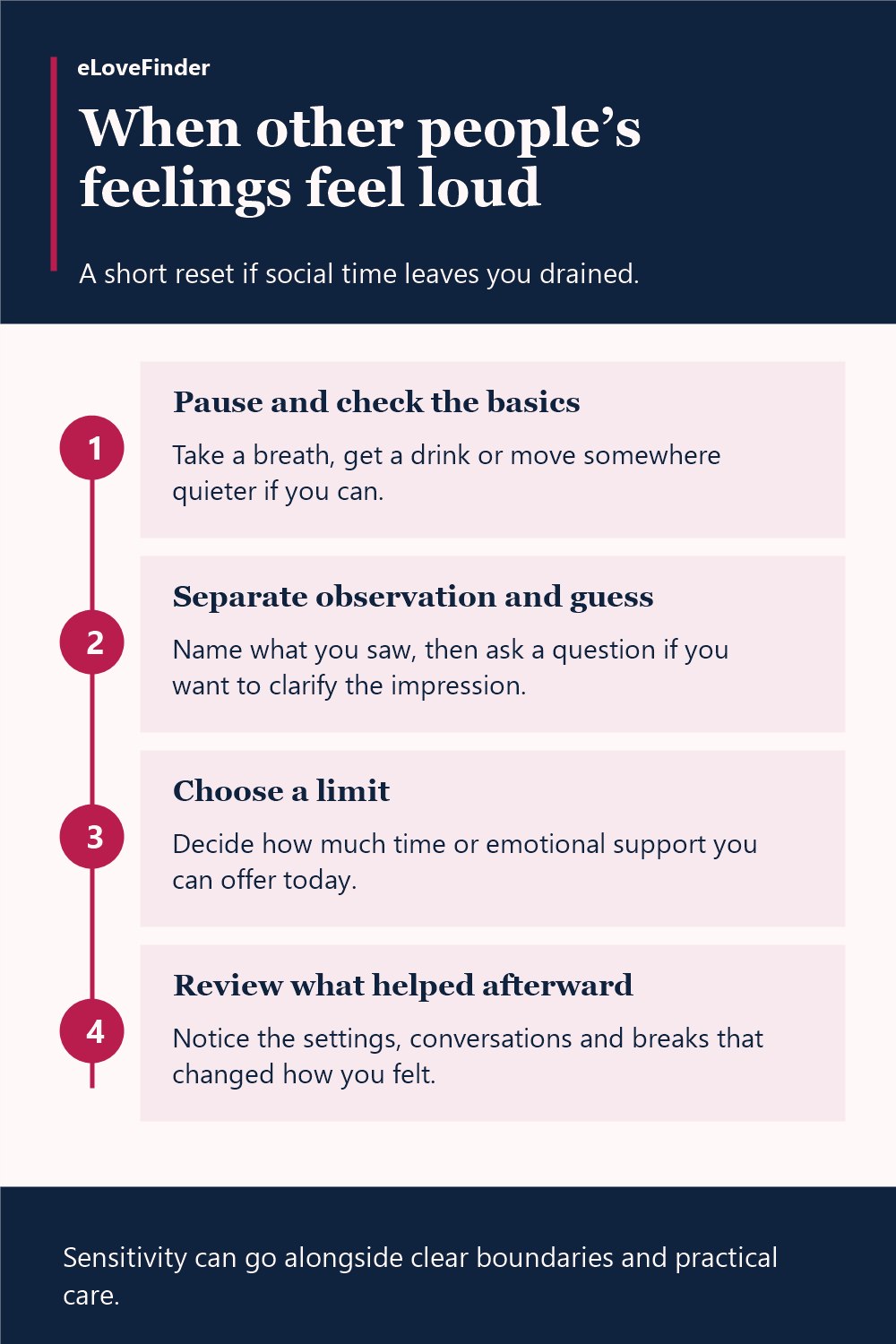
Read the infographic in text
When other people’s feelings feel loud A short reset if social time leaves you drained.
- Pause and check the basics Take a breath, get a drink or move somewhere quieter if you can.
- Separate observation and guess Name what you saw, then ask a question if you want to clarify the impression.
- Choose a limit Decide how much time or emotional support you can offer today.
- Review what helped afterward Notice the settings, conversations and breaks that changed how you felt.
Sensitivity can go alongside clear boundaries and practical care.
‘Watch what you eat’? I’m all in for healthy eating but attributing energy sensitivity solely to diet feels overly simplistic. Emotional states are complex and influenced by multiple factors—it’s not just about food choices.
I disagree with you, Dan48! Being an empath is not about avoiding responsibility; it’s about recognizing sensitivity as a strength. Empathy leads to deeper connections with others, which can be powerful if managed well.
The concept of empaths is fascinating and scientifically grounded in psychology. Understanding how energy transfer works can help us navigate our emotions better. It’s essential to differentiate between our feelings and those of others for emotional clarity.
‘Find out where the emotions come from’? Sounds simple enough in theory, but in practice, it’s a lot more complicated than just sorting through feelings like laundry! Emotional intelligence is hard work that takes time.
Honestly, I find this whole idea of being an empath kind of ridiculous. It’s just a way for people to excuse their sensitivity and emotional reactions. Everyone has feelings, but it doesn’t mean we need special titles or rules for it.
This article offers a comprehensive look at the challenges empaths face in today’s world. Setting boundaries is crucial, and the meditation advice is something many could benefit from. Understanding one’s emotions is key to personal growth.
This article feels a bit too ‘new age’ for my taste. While I understand the notion of being sensitive to energies, the whole idea of shielding and cleansing seems overly dramatic and unscientific. Can’t we just focus on rational solutions?
‘Know what takes your energy’ is such important advice! I’ve learned over time who and what drains my spirit, and it’s liberating to set those boundaries. Self-awareness is key, especially when surrounded by negativity!