

When a partner withdraws during difficult conversations, it can be hard to know whether to give them space or try again. Begin with what you can observe and what you need, rather than deciding that an attachment label explains the whole relationship.
A pause may be useful when both people understand what it means and how they will reconnect. It becomes a different problem when important questions are repeatedly left unanswered. Your partner can need space, and you can need clarity; both deserve consideration.
On this page

Describe the pattern
Choose a recent example. “When I asked about the cancelled visit, we stopped talking and haven’t returned to it” gives the conversation a starting point. “You always run away from intimacy” makes a broad claim about someone’s motives that you may not be able to know.
Ask what happens for them in those moments. They may feel overwhelmed, need more thinking time, dislike the way a disagreement develops, or not want the same relationship. Listen without deciding in advance that there must be a hidden wish for closeness beneath every refusal.
You do not need to classify a partner as avoidant, establish what happened in childhood, or prove that a label is correct before describing the effect on you. If they use attachment language themselves, you can ask what it means for their practical choices rather than treating it as a fixed forecast.
Ask for a workable conversation
Start with one issue and one request. For example: “I’d like us to agree on how we handle changes to weekend plans. Could we talk for fifteen minutes after dinner?” A defined topic can be easier to approach than a demand to resolve the whole relationship at once.
Ask whether the timing and format work for both of you. A short walk, a seated conversation or a brief written outline may help you begin. Avoid sending a series of messages to force an answer or expecting one person to be available whenever the other is ready.
You can write down your point beforehand: what happened, how it affected you, and what you would like next time. During the conversation, check that you understand their answer. Understanding does not require agreeing to an arrangement that leaves your needs unmet.
Agree on space and a return
If either person needs a pause, discuss a realistic return point. “Let’s stop for now and check in tomorrow evening” gives you both a plan. There is no single correct length for every pause; what matters is an agreement you can both use and revisit.
Clarify what space means. Are you pausing this discussion, spending an evening separately, or reconsidering the relationship? Do you still need to communicate about children, travel or another shared responsibility? Vague terms can leave each person following a different plan.
Respect privacy during a break. Checking accounts, following someone’s location or contacting their friends to find out what they are doing is not a substitute for an agreed check-in. If they ask you to stop contacting them, respect that limit rather than searching for another route in.
Love is respect’s guidance on emotional boundaries includes questions about support, consistency and comfortable time apart. You can use those topics to discuss what each of you needs from space.
Check whether effort is shared
After a pause, notice whether the conversation actually resumes. Does your partner help find a solution, express a different preference, or acknowledge a missed agreement? Reconnection involves more than returning affectionately while the original concern remains off limits.
Be reliable about your own agreements, and expect participation from them too. You do not have to prove loyalty by accepting every cancellation, suppressing questions or taking responsibility for their feelings. Patience is a choice, not an obligation to wait without limits.
Keep enjoyable time together if you both want it, but do not make a shared hobby carry a conversation it cannot answer. A pleasant outing may help you feel connected; it does not establish agreement about commitment, contact or a recurring conflict.
Decide what you can continue
State a boundary in terms of your own action: “I need us to be able to discuss shared decisions. If we can’t return to this, I will make separate plans.” Choose something realistic, rather than a threat intended to make the other person disclose more.
If both people want help with recurring communication problems, you can discuss support from a qualified couples professional. Individual support is also an option while you consider your choices. If you fear retaliation, threats or controlling behaviour, seek private specialist support before planning a joint confrontation.
You may try another specific agreement, take distance or decide this relationship is not workable. Someone can have understandable difficulties and still be unable to offer what you need. Compassion for their experience does not remove your right to choose a relationship with room for your voice.
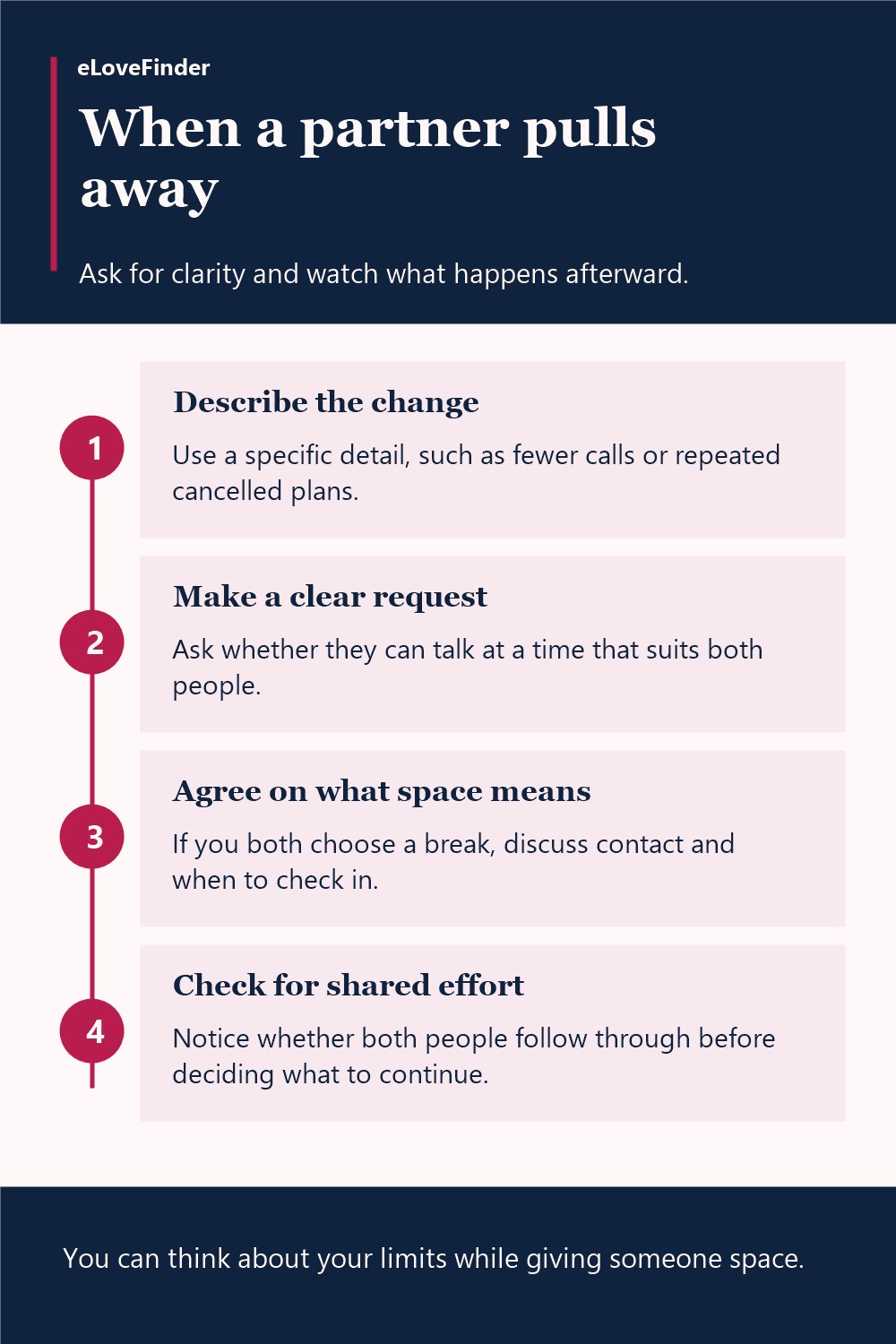
Read the infographic in text
When a partner pulls away Ask for clarity and watch what happens afterward.
- Describe the change Use a specific detail, such as fewer calls or repeated cancelled plans.
- Make a clear request Ask whether they can talk at a time that suits both people.
- Agree on what space means If you both choose a break, discuss contact and when to check in.
- Check for shared effort Notice whether both people follow through before deciding what to continue.
You can think about your limits while giving someone space.
While the article has some valid points, it oversimplifies the complexities of human relationships. Not everyone fits neatly into these categories, and there are many factors at play. Attachment styles are just one piece of a much larger puzzle.
Exactly! Relationships can’t be boiled down to simple labels. Each person’s experience is unique and deserves more nuance.
I agree with you! The idea of fitting everyone into just three attachment styles is limiting. People are far more complex than that.
Did you know that attachment theory is rooted in psychological research? It’s fascinating how our early experiences shape our adult relationships. This article highlights some effective strategies for dealing with avoidant partners, which can be very helpful!
This content is incredibly informative! Learning how to communicate effectively with an avoidant partner can make all the difference in a relationship. The tips shared here are practical and easy to apply in real-life situations!
‘Be patient’—great advice if you’re into waiting indefinitely! It’s vital that both partners contribute equally in a relationship. Otherwise, one person ends up feeling neglected and unvalued.
‘Waiting indefinitely’ is such a dramatic take on it! Patience is key in any healthy relationship; it’s not about neglect but understanding each other better over time.
‘Let them come to you?’ Really? That sounds like a recipe for loneliness! If you’re in a relationship, shouldn’t both partners actively engage? The advice here seems too passive and unrealistic for real-life situations.
‘Talk about your health?’ This sounds more like relationship advice from a therapist than practical tips! Can we just acknowledge that navigating emotional issues takes more than just chatting about daily feelings?
Honestly, this post oversimplifies a complex issue. Not all avoidant individuals behave the same way, and generalizing their feelings and reactions can lead to misunderstandings. We need more nuanced approaches than what’s presented here.
‘Avoidant people don’t play hard to get’? Sounds like something you’d read in a dating manual from the ’90s! Relationships are much more complicated than these blanket statements suggest.
@Adrian Clarke, I think you’re missing the point here. Sure, people have different experiences, but attachment theory gives us a framework to understand behaviors that often recur in relationships. It’s not about boxing people in.