

A promising relationship shows up in ordinary moments: how someone handles a change of plans, listens to a concern or responds when you need time to yourself. Give yourself time to notice what both of you do in different situations.

1. You can count on what they say
People miss calls and plans change. Notice whether they tell you what happened, reschedule if they can and follow through on the new plan. Over time, this can make it easier to ask where you stand.
2. You can disagree without being punished for it
Can both of you finish a thought? If either needs a break, do you agree when to come back? A repair can be as simple as saying, “I interrupted you. What were you trying to tell me?”
3. You enjoy being together in ordinary settings
Try a walk, an errand or a quiet meal. Give yourself time to notice how it feels when there’s no elaborate date to plan. Butterflies can be part of attraction. It also matters whether you feel free to be yourself.
4. You can move at a pace that works for both of you
You can like someone and need more time. Say what pace you want and notice whether they respect it. Give yourself room to take discomfort seriously, even when other people think you make a good match.
5. You have room for friends and interests of your own
See what happens when you want an evening alone or already have plans. When you both respect those choices, there is space to miss each other and have something to share when you get back together.
6. You take an interest in how each other wants to live
Ask what a good week looks like, how each of you wants to handle money and what you picture for the next few years. Listen for what you can agree on and what may be hard to accommodate.
For more prompts, see 15 questions about whether a relationship fits and ways to talk when your partner pulls back.
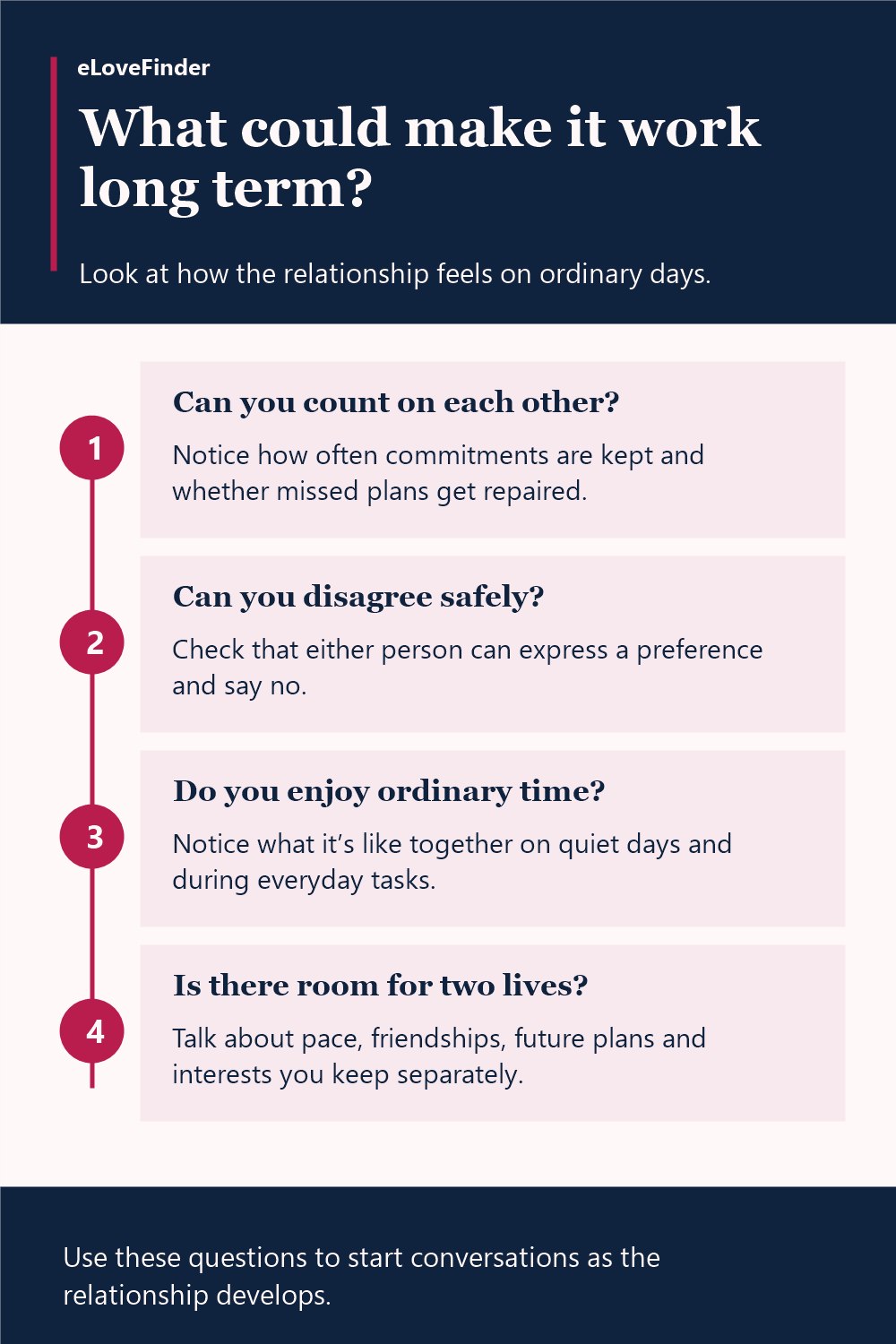
Read the infographic in text
What could make it work long term? Look at how the relationship feels on ordinary days.
- Can you count on each other? Notice how often commitments are kept and whether missed plans get repaired.
- Can you disagree safely? Check that either person can express a preference and say no.
- Do you enjoy ordinary time? Notice what it’s like together on quiet days and during everyday tasks.
- Is there room for two lives? Talk about pace, friendships, future plans and interests you keep separately.
Use these questions to start conversations as the relationship develops.
‘You feel emotionally grounded’—what does that even mean? Can someone explain this in simple terms? Relationships are complex, and this article makes it sound like there’s a checklist to follow.
I find it quite amusing how the article mentions ‘butterflies.’ Really? Are we still in high school? True love involves a lot more than just feelings; it’s about commitment and shared goals.
‘Fighting fair’ sounds great in theory, but let’s be honest: most couples don’t even know how to communicate effectively during disagreements. This section feels overly optimistic and doesn’t reflect reality for many.
This article provides some insightful perspectives on love! The idea that you might push a good partner away because of past experiences is something many overlook. It’s important to recognize and heal those wounds.
While I see the points made, I think the article is oversimplifying relationships. Life isn’t always about finding ‘perfect’ partners, and real love is often messy and complicated. This feels too idealistic.
‘You like time apart?’ Haha, that’s rich! If I wanted time alone, I’d stay single! Relationships are all about togetherness… or at least that’s what my grandma always told me!