

Wanting more love in your life can mean wanting a partner, closer friendships or more everyday care. If manifestation is meaningful to you, you might use an intention, prayer or journal entry to describe that hope. Give the hope something practical to connect with: a choice you can make, an invitation you can offer or a relationship you want to understand better.
You do not need to feel positive all the time or become perfectly confident before someone can love you. Being single, grieving or struggling with self-worth does not mean you have sent out the wrong energy. Another person’s feelings and decisions remain their own, however strongly you wish for a connection.
On this page
1. Practise care without making love a reward
Self-love can sound like a large task when you already feel lonely or hurt. Start with a smaller question: “What would make today a little kinder or more manageable?” Your answer might be eating something, resting, asking for company or declining a plan you do not have capacity for.
You can care for yourself while still having doubts, sadness or an inner critic. Try answering a harsh thought with something believable. Instead of insisting “Everyone will love me,” you might say, “This rejection hurts, and it does not tell me what every future connection will be like.” You do not have to force an affirmation that feels false.
The NHS guidance on healthy relationships suggests realistic alternatives to unhelpful thoughts, alongside listening, boundaries and time for yourself. Choose an idea that fits the situation rather than treating positivity as another standard to meet.
If you have been mistreated, responsibility belongs to the person who chose that behaviour. You did not cause it by lacking self-love. Support from trusted people or a qualified professional can be part of caring for yourself; you do not have to resolve everything alone before you deserve a relationship.
2. Turn an intention into a choice
The law of attraction is a belief some people use to make sense of hope, attention and possibility. You may find that language encouraging. Treat it as a personal framework while allowing for uncertainty: a thought, ritual or imagined future cannot establish that a particular person wants a relationship with you.
Describe what you want in terms of shared behaviour. “I want a loving relationship” might become “I want affection we both welcome, reliable plans and room to disagree respectfully.” This gives you something to ask about and notice as you get to know someone.
Separate what you can choose from what needs another person’s agreement:
- Your choice: ask someone on a date, update an honest dating profile or make time for a conversation.
- Their choice: accept, decline, reply or want a different kind of connection.
- A shared decision: whether to date again, become exclusive or change an existing agreement.
A clear invitation can leave space for either answer: “I’ve enjoyed talking with you. Would you like to meet for coffee next week?” If they decline, accept that answer. Repeated messages, attempts to change their mind or interpreting silence as hidden love will not create mutual consent.
If you enjoy visualising, picture how you would like a relationship to feel and work, without assigning someone a role they have not chosen. Afterwards, identify one useful action. You can keep the spiritual meaning of the practice while judging a connection by the choices both people actually make.
3. Use quiet reflection in a way that suits you
A pause may give you space to notice what you want before you act. You could sit quietly, pray, write a few sentences, look out of a window or take a short walk if that is accessible. Meditation is one option; it is not a requirement for finding love.
Try a brief reflection with no target feeling to achieve:
- Name the wish. For example, “I would like more companionship.”
- Notice the present. What are you feeling, and what support or practical limits matter today?
- Choose one next step. Perhaps contact a friend, suggest a date or give yourself an evening without dating apps.
If focusing inward feels uncomfortable, stop or try something external, such as noticing objects around you or doing an ordinary task. You do not have to push through distress, empty your mind or finish a certain number of minutes to make the practice count.
Words such as energy, vibration or chakras may express your spiritual experience. They do not tell you whether another person is available, interested or treating you well. Bring those questions back to conversation and behaviour. A meaningful feeling can accompany a relationship decision without making the decision for you.
4. Make room for connection in everyday life
Choose an opportunity that fits your time, money, access needs and preferences. You might attend a recurring interest group, accept a friend’s introduction, use a dating app with clear intentions or reconnect with someone you already know. An activity can still be worthwhile when it does not lead to romance.
Build on existing care too. Ask a friend to share a meal, suggest a regular call or tell someone you appreciated their support. Friendship, family, community and romantic relationships offer different kinds of connection; you do not have to make one person meet every need.
As a new connection develops, notice mutual effort. Are invitations sometimes returned? Can you ask for what you need? Are your limits respected? If the effort stays one-sided, you can ask for clarity or step back instead of treating the difficulty as a sign to manifest harder.
At the end of the week, review something you could observe: “I made an invitation,” “We had an honest conversation,” or “I respected a no.” These are useful choices even when the outcome is disappointing. Change the plan if it is draining your time, money or confidence.
If you are already partnered, ask about one small change you would both welcome, such as time together without interruptions or a fairer way to share a task. Appreciation and reflection can accompany that conversation; practical problems also need practical agreements and follow-through.
Let hope leave room for the life you have now. You can want a relationship, enjoy spiritual practices and make room for other sources of meaning at the same time. Love is not a prize you must earn by staying cheerful or suppressing your needs.
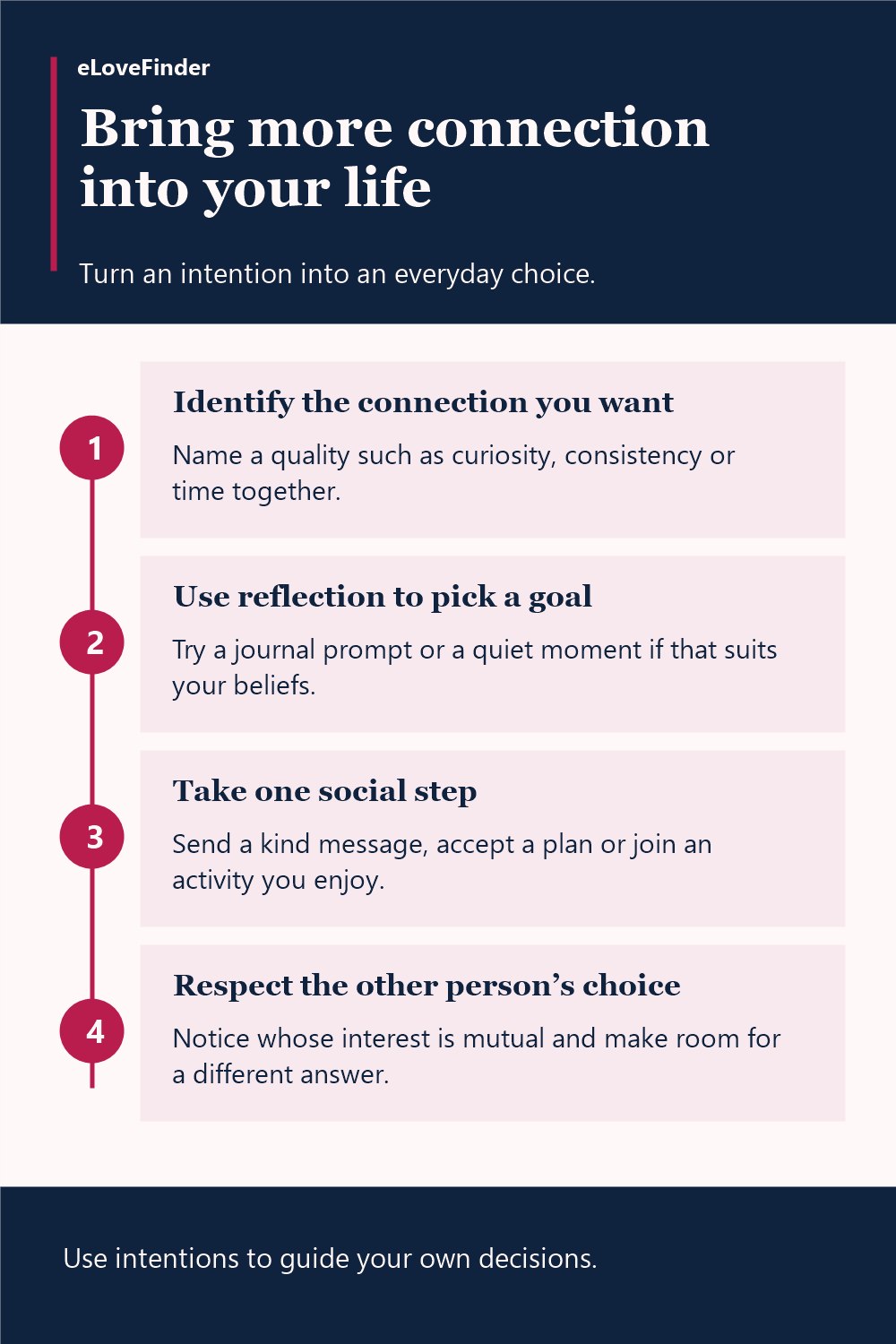
Read the infographic in text
Bring more connection into your life Turn an intention into an everyday choice.
- Identify the connection you want Name a quality such as curiosity, consistency or time together.
- Use reflection to pick a goal Try a journal prompt or a quiet moment if that suits your beliefs.
- Take one social step Send a kind message, accept a plan or join an activity you enjoy.
- Respect the other person’s choice Notice whose interest is mutual and make room for a different answer.
Use intentions to guide your own decisions.
‘Loving yourself’—sure, sounds easy enough, right? But how many of us have actually mastered it? This feels like another one of those feel-good articles that oversimplifies something complex.
While I appreciate the intention behind this article, it feels overly simplistic. Not everyone can easily practice self-love, especially those dealing with deep emotional trauma. It’s important to acknowledge the complexities of mental health rather than glossing over them.
This piece is a good reminder that self-love is crucial for healthy relationships. The Law of Attraction is fascinating, and I believe that maintaining a positive mindset does impact our interactions. Just a gentle nudge to anyone struggling: healing takes time, so be patient with yourself!
‘Love yourself’—that’s the answer? How naïve! If only it were that simple, we’d all be living in blissful relationships. Life is complicated, and merely chanting positive mantras won’t solve real issues people face in love.
“Raise your vibrations”? Is this an article or a new-age sales pitch? It seems like just another way to sell positivity without addressing the actual struggles people face in finding love. Let’s keep it real here.
While I appreciate the emphasis on self-love, it’s a bit naive to think that positive thinking alone can solve deeper issues. Sometimes, people need more than just mantras to heal and find love. Life isn’t that simple.
Exactly! It’s almost as if the article suggests ignoring real-life problems in favor of some magical thinking. We should be addressing emotional trauma with professional help instead of just wishing for love.
‘Talk to yourself as if you are your own best friend.’ This is such an insightful point! We often forget how harshly we judge ourselves compared to others. Implementing kindness in our internal dialogue can truly transform our perspectives on life and love!
‘Positive vibes only’ seems to be the motto here! While I agree that positivity helps, life isn’t all sunshine and rainbows; we have struggles that need addressing too. It’s not all about vibrations!